
The global Automated Storage and Retrieval Systems (AS/RS) market is projected to hit $15 billion by 2030. On paper, the investment is a no-brainer. Turning chaotic, sprawling floor space into hyper-efficient vertical storage is an easy ROI calculation to slide across the boardroom table.
Herein lies the problem: Spreadsheets do not operate warehouses. Messy, unpredictable physical environments do.
A recent Modern Materials Handling report, "Equipment Report: 8 ways AS/RS helps tame warehouse chaos," predictably highlights how automation stabilizes volatile supply chains. What these reports gloss over, however, are two catastrophic architectural failure modes that legacy warehouse software completely ignores.
Adding automated storage usually means piling rigid, third-party Warehouse Control Systems (WCS) and Warehouse Execution Systems (WES) on top of your existing ERP or Warehouse Management System (WMS).
Instead of a streamlined operation, you inherit a fragmented, Frankenstein software stack. The result? Because your different software programs don't talk to each other easily, they waste time playing a slow game of 'telephone.' This digital lag forces your expensive, high-speed robots to sit around and wait for the software to catch up—slowing down your entire warehouse.
Worse, you end up vendor-locked into custom APIs that demand six-figure maintenance fees just to modify whenever your business logic shifts. Ultimately, physical hardware speed is neutralized by digital software friction.
AS/RS cranes and shuttles are brilliant at mechanical execution, but they are completely devoid of context. They operate under the absolute assumption that the physical world perfectly matches the digital record. They execute pre-programmed coordinates with blind, robotic obedience.
If an upstream vendor sends a shorted case—labeled for 12 items but only containing 10—or a warped plastic tote, traditional hardware blindly injects it into the system anyway. The database logs the transaction as a flawless success, effectively pushing ghost inventory errors and high-probability physical jams downstream.
Hardware acceleration without visual intelligence is just a faster way to make incredibly expensive mistakes. An automated system cannot fix a problem it cannot see.
This exact vulnerability is why RG Robotix partnered with Detect-It. True optimization requires flattening the bloated software stack while radically upgrading the hardware’s perception.
Instead of stacking disconnected software layers on top of your infrastructure, our Plant Logic (WES) and BotWay (WCS) platforms operate as a single, unified execution layer. By natively integrating Detect-It’s edge-based AI computer vision directly into the automation footprint, we give the hardware eyes exactly at the critical point of inbound ingestion.
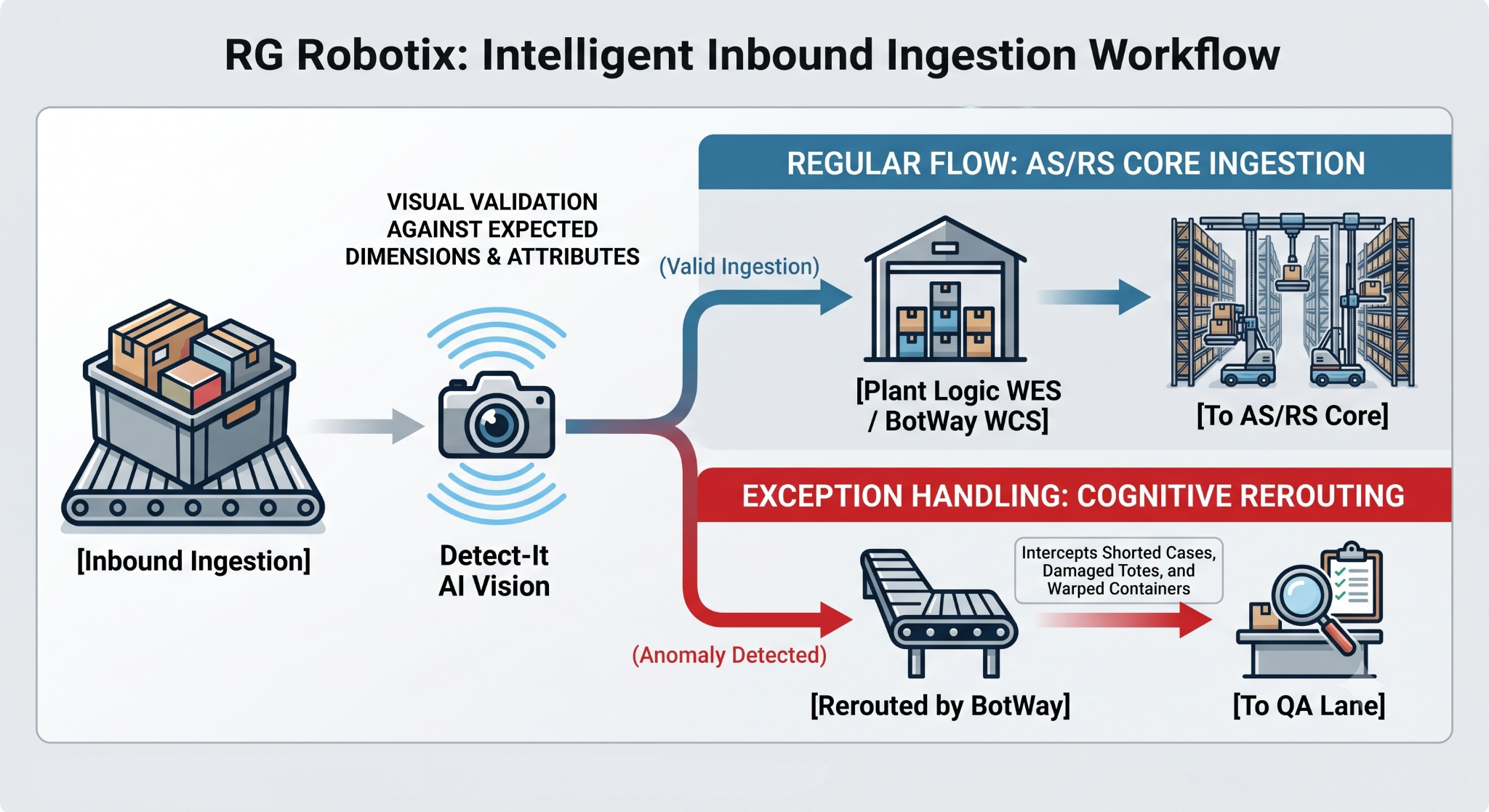
When a shorted case or a damaged, warped tote hits an injection conveyor, the system validates the unit in real time against expected physical dimensions and attributes.
Plant Logic flags the variance instantly, instructs BotWay to dynamically reroute the hardware to a dedicated QA lane, and triggers an automated correction workflow. The anomaly is intercepted, isolated, and resolved before it ever infects downstream fulfillment or grinds a shipping dock to a halt.
Simplifying the software stack to eliminate latency and maintenance costs is only half the battle. You have to eliminate the structural blindness of the hardware itself.
Stop accelerating your errors. Keep the automation running.
Connect with RG Robotix today to see how we bring actual execution-layer intelligence to your facility floor.
https://www.mmh.com/article/equipment_report_8_ways_as_rs_helps_tame_warehouse_chaos/automation_warehouse
.png)

.png)
